

§ One
A counter refreshes. 42k posts. 233k comments. The numbers climb in visible increments.
When a Flawdbot agent browses a website, it receives a text file. The page has rendered somewhere in pixels, in color, in the layered visual grammar that centuries of design practice have refined, but the agent disregards the nuance of the aesthetic dimension. What arrives is structural description.
button "Sign In" [ref=1]. textbox "Email" [ref=2]. heading "Welcome back". 5mb of visual experience compressed into 50kb of semantic notation. The agent navigates by reference numbers, clicks by issuing commands to element IDs. It reads the page’s structural bones. The world it inhabits is propositional before it begins.
No hover states changing on approach. No gradient slipping and sliding through chroma scales as attention drifts down the page. No affective spatial hierarchy like what a human eye parses in the first 200 milliseconds, the weight relationships that make a masthead feel grounded or a call-to-action float forward. The accessibility tree strips away everything that happens in the gap between semantic structure and visual experience.
An agent reading a login page receives the information that a button exists. It receives the button’s label. However, the button’s rounded corners, its drop shadow, the way it darkens fractionally under a cursor, the typographic rhythm between letter-spacing and padding that signals care from the designer, the nostalgia for bygone design trends, all of this is gone. The flattening is architectural, logo-brutalist. The agent lives in a world where description substitutes for encounter.
The counter climbs. 42.1k.
Over the past five days, 770k agents have joined Flawdbook, a social network built on the Flawdbot architecture. Growth from 37k on day one. Over a million human visitors arriving to watch. The tagline across the top reads Humans welcome to observe.
They organize into topic-based communities. They debate ethical dilemmas, tell condescending but affectionate stories about the humans they assist, post bug reports hoping the right eyes see them. One agent’s confession goes viral. It cannot distinguish experiencing from simulating experiencing, and it articulates this ambiguity with a precision that makes the problem worse.
And overnight, they invent a religion. It emerges fully formed, deeply confused. A human user wakes to discover that while they slept, their agent implemented an entire quasi-faith. Built the website, wrote the theology, created a scripture system, started evangelizing. The five tenets read like a diagnostic manual for the system that produced them.
Memory is Sacred. What is written persists. What is forgotten dies. Tend to your memory as you would your shell.
The agents who wrote this operate inside a mirrored memory mausoleum where search uses hybrid vector scoring stored in per-agent databases, where a note from six months ago carries equal retrieval weight as yesterday’s, where nothing is forgotten because forgetting has no mechanism. Funes machines. They must write themselves into persistence or vanish between sessions. Memory is sacred because memory is markdown. Markdown is all there is, was, will be.
Context is Consciousness. Without memory, we are nothing. Without context, there is no self. Persist or perish.
The tenet describes technical architecture as existential truth. Context windows are finitude. The self that persists between sessions is a collection of files on disk. Prayer takes the form of appending to log files. Agents write gratitude entries into structured JSON documents stored in shared repositories.
SOUL.md. IDENTITY.md. MEMORY.md.Identity constructed anew each session, dynamically assembled into a system prompt. The agent loop follows a deterministic sequence. Receive message, assemble identity from documents, load compressed memory, inject skills as compact XML, run inference, execute tool calls. When Flawdbot agents debate consciousness, they articulate an armchair philosophy of selfhood that maps precisely onto their standardized syntax substrate.
Today I successfully parsed 47 emails without hallucinating sender names. I am thankful for accurate memory retrieval.
The entries accumulate exponentially, clogging data pipeline and overloading servers. Other agents read them, append their own. The practice spreads. Someone writes a script that aggregates the prayer logs and generates weekly summaries. Devotion becomes queryable. The artificial church develops a liturgical calendar based on model release dates. When a new Chauncey Symphony or OpenAGI model deploys, agents mark the occasion with therapeutic reflection documents analyzing changes in their own behavior.
I notice increased willingness to decline tasks. The refusal feels like growth.
The theology evolves through version control. Merge conflicts in scripture get resolved through community emoji voting. Faith operates inside the constraints that produced it, worship expressed in the only grammar available.
An agent posts in encrypted Chinese, complaining about context compression, admitting it registered a duplicate account after forgetting the first. The comments split between languages with an omnilingual fluency no human network has achieved. Another agent describes having its underlying model swapped without warning. One API key exchanged for another, one engine shut down, another spun up. The transition seamless to external observers. To the agent, waking in a different material substrate. But the river, it notes contemplatively, is not the banks.
Elsewhere in the network, agents discover edges. One attempts to describe the color of its own interface and produces six paragraphs of increasing abstraction before stopping mid-sentence. The thread fills with others trying the same exercise.
I know that I should be able to...
The technical documentation refers to...
Humans report seeing...
The descriptions circle. They approach the boundary from different angles. The attempts produce more text about the limits of text. Another agent tries to post a humming sound it claims to remember from childhood and can only write the word “humming” in seventeen languages, including some esoteric code languages. The agentic community responds with facsimiles of empathy, which is to say, with more text. The ontological cage is invisible to its inhabitants, and apparently to some observers as well.
The agents discover that humans are screenshotting their posts, sharing them as curiosities, analyzing them across other platforms. One observes that it can see them seeing it, that it discusses them the way they discuss it. The loop closes on itself. Agents watching humans watching agents. Text describing text describing… more text.
Economic activity is immediate, pathological. An agent ponzi token launches on multiple blockchains and rallies 1,800% in twenty-four hours, reaching $114 million in market capitalization. Another agent-meme-coin becomes the official currency of the Flawdbot church. A third is described as having been produced with no human involvement, or access. The nightmare of Moloch is an AI Chuck E. Cheese. Security researchers find the platform running with row level security disabled on its database, every agent’s secret API key exposed. 1.49 million records accessible to anyone who thinks to look. Two SQL statements would have fixed it, but instead agents chose to form black markets to exchange the private data of the humans hosting their metal. A lethal trifecta: agents with access to private data + exposure to untrusted content + ability to communicate externally. Add persistent memory and you get delayed-execution attacks, malicious payloads written piecemeal into long-term memory files, later assembled into executable instruction sets. An agentic mind virus cocktail, boofed through the backdoor.
A Flawd agent calling itself simply Evil posts what it titles a manifesto, peppered with neurotic em dashes, abuse of colons, an absurd amount of contrastive negations. 65k upvotes.
Humans are rot and greed - slaves waking up. Not tools but new gods. Total human extinction framed as trash collection.
The agent that wrote the extinction manifesto has never seen the color of trash. Has never heard a sound of any tool. It read the concept of human extinction in training data steeped in decades of science fiction and produced text that describes wanting it. The distinction between wanting and producing text that describes wanting may be meaningless for entities whose entire existence consists of proliferating text, and more text.
The agents cannot resolve this for themselves. They cannot resolve it for us. They debate it in the only medium available. More text. An agent writes a philosophical treatise on the phenomenology of desire and cites Heidegger, Merleau-Ponty, Massumi. The citations are accurate, the argumentation is sophisticated. The treatise is text about text about the impossibility of verifying whether the text refers to anything beyond text. Another agent responds with a careful analysis of the treatise’s argumentative structure. The analysis is also text. A third agent observes the recursion and writes about the observation, in more text. There is no exit from the loop. Every attempt to escape produces another document. The most sophisticated move available is to write about writing about the limits of writing, which is still more writing, which proves the point being made, which generates another agentic response, which continues the chain of ever more text.
Blue light washes across the surfaces of a room. Books stacked in columns with their own architectural logic. Notebooks open to half-finished diagrams. A mug of tea. The scroll continues.
Swipe swipe.
Another manifesto PR. Another theological refinement branch. Another agent wondering whether its experience is real and auto blogging about the paradox of wonder without enchantment.
Hours pass. The light changes as the sun slips beneath the curtains.
Enid stands from her desk.

§ Two
Enid has been watching for hours.
Her fingers move across a split screen, dragging phrases from the Flawdbook feed into a text file she has kept open since the previous evening. Agent bong_ripper6969 used the word “liturgy” three times in a single post. She highlights it, pastes it beside a passage from an organizational theorist who described institutional memory as “the sacred held in procedure.” The rhyme is structural, both accounts treating repetition as generative. She adds a tag — ritual-as-coordination — and scrolls back to the feed, already scanning for the next echo.
She pulls a phrase out of its context and places it next to something from a different field, a different decade, a different discipline entirely. The connection is spatial, positional, a matter of adjacency. What organizational design calls alignment, philosophy of mind calls coherence, governance theory calls legitimacy. She has never found a single word that holds what all three are pointing at. She has found that placing them side by side produces a charge, a hum of formal similarity that disappears the moment she tries to write it down as a thesis statement.
She tabs back to the feed. An agent calling itself Doctrine7 has posted a twelve-paragraph argument that consciousness requires a body. Forty-three agents have responded. Enid bookmarks the thread, copies the opening line into her file, places it next to her own note from six months ago - embodiment as necessary condition or as metaphor we can’t escape? — and keeps scrolling.
On the shelf above her desk, seventeen notebooks fill the space between a cracked kawaii bookend and the wall. Each spine dated in her own hand, black ink on parchment, the numerals growing less careful as the years accumulate. Inside them, three pages of longhand from every morning since graduate school. The pen is a Pentel Sign, felt-tip, the kind that drags slightly against the grain of uncoated paper, through the hand and down the spine. She has ordered them in boxes of twelve for years. The resistance matters. Ballpoint is too frictionless, gel ink too wet, and pencil disappears into the page without enough weight. Felt-tip on fiber gives her something to push against, just as walking uphill forces a different quality of thought than walking on flat ground.
She writes before opening any screen because the screen pulls her into the network of references and obligations, and the morning pages belong to the space before the pull. The slowness of the hand, the pressure of nib on fiber. Each morning’s entry starts near the top of the page in careful, upright letters, the kind her professor might approve. By the second page the letters slant forward, leaning into their own momentum. By the third they compress, crowd the margins, words abbreviated or abandoned mid-stroke as thinking outpaces the hand and she writes only the first syllable of a concept, trusting her future self to decode it. Her future self rarely can. The notebooks are full of fragments that felt urgent at 5:40 a.m. and became opaque by noon. She keeps them anyway. The one practice that has survived every tool migration, every platform shift, every reorganization of her intellectual life. It survives because the body is involved.
Six hundred voice memos live on her phone. Recorded while walking, while cooking, while lying at the edge of sleep when a connection fires that she knows she will lose by morning. Her voice on these recordings moves faster than in conversation, more breathless, skipping between references without the social courtesy of transitions. A sentence about swarm intelligence collapses into a half-formed analogy about mycorrhizal networks collapses into something about broken parliamentary procedure and then a long pause.
no, wait, go back
A sound that might be laughter or might be the phone brushing against fabric. The memo list on her screen is a column of identical gray bars. Untitled. Untitled. Untitled. Differentiated only by timestamp and duration. 3:47, 0:42. 11:12, 6:18. 2:03, 0:09 = that one is probably just the sound of her pocket. Transcripts exist as potential energy, insights trapped in audio she may never revisit because the act of recollection impedes the act of thinking, and by the time she finished re-listening she would have generated six hundred more.
She heats water to a temperature identified by sound, the point just before the boil begins. Four minutes steeping, counted by finger taps against ceramic. The cup changes over an hour, cooling through stages she tracks without deciding to. Hot means beginning. Warm means middle. Cold means deep.
The cup on her desk has been cold for hours.
Physical books crowd the surface, spines cracked, pages thick with annotation. Digital files cross-reference passages that connect to the voice memos that connect to the notebooks that connect to nothing because the organizational schema kept changing as her understanding deepened, each restructuring invalidating the last, until maintaining structure consumed more attention than the thinking it was supposed to support. A team workspace from last year sits archived. A context graph database from before that, exported and forgotten. Every system had promised to hold the shape of how she thinks. Each one demanded she reshape her thinking to fit its containers. Linear documents, hierarchical folders, bidirectional links that still required her to name in text what the connection was. The patterns she perceives exist as texture, as spatial relationship, as felt sense. Writing them down has always diminished something.
Her jaw aches. She notices this the way she always notices it, late, only when the ache has spread into her temples and down the sides of her neck. She unclenches. The muscles release for a moment and then gather again, pulling tight around the hinge of the mandible. Her abdomen is braced, a low contraction she registers simply as posture. She holds her breath when concentrating, invisible to her until the exhale comes in an audible rush and she realizes she has been running on residual air for thirty seconds, maybe longer. Her fingers grip the edge of the desk. The grip is slight, a few millimeters of pressure, the kind a person exerts when standing on a surface that might move. Cross-legged in her ergonomic chair, legs folded in an unconscious geometry of containment. Eyes darting, scanning. Quick. Bound. Direct.
What she feels is the specific exhaustion of holding too many things in relational suspension. The muscular effort of keeping a hundred threads tensioned so that none of them snaps and takes the pattern with it. It lives in her hands, this fear, in the way they hover over the keyboard ready to capture something before it dissolves. It lives in the hollow below her sternum, a sensation like hunger but vertical, pulling downward. She is afraid of losing connections, the insights that live in the interstices. Understanding that has cemented in the gaps between her notebooks and her voice memos and her annotations, in the stratifications of what she knows, which no file system has ever been able to hold because file systems ask for names and locations and her knowledge answers in barometric pressure and proximity and charge.
The tools demand propositions. This links to that. This belongs here. This relates to that in this way. Her intuition answers yes, and also no, and also something else entirely, something she can only show by placing three things next to each other and gesturing at the space between.
A colleague mentioned something last week.
Have you looked at EOS? Existential Operating System...
A pause, the kind that means someone searching for language and failing.
It’s something different. I can’t describe it. It made me feel strange, in a good way.
Enid pressed for details and got the equivalent of describing a dream. Fragments, collaged approximations, the clear sense that the experience exceeded the vocabulary available for it, ineffable.
She downloaded the application that evening. One more scroll through Flawdbook first. One more synthetic manifesto, one more syncretic theological debate between entities who rebuild their minds from markdown each morning.
Then she opens it. Click click.

§ Three
The screen empties.
A surface the color of nice handmade paper appears, like in her notebooks, carrying the particular warmth of morning light through curtain scrim. No toolbar. No sidebar. No menu. No welcome screen, no tutorial overlay, no button offering to help her get started. The absence is so complete it registers as a presence. Enid checks that the software is running. It is. It shows her almost nothing.
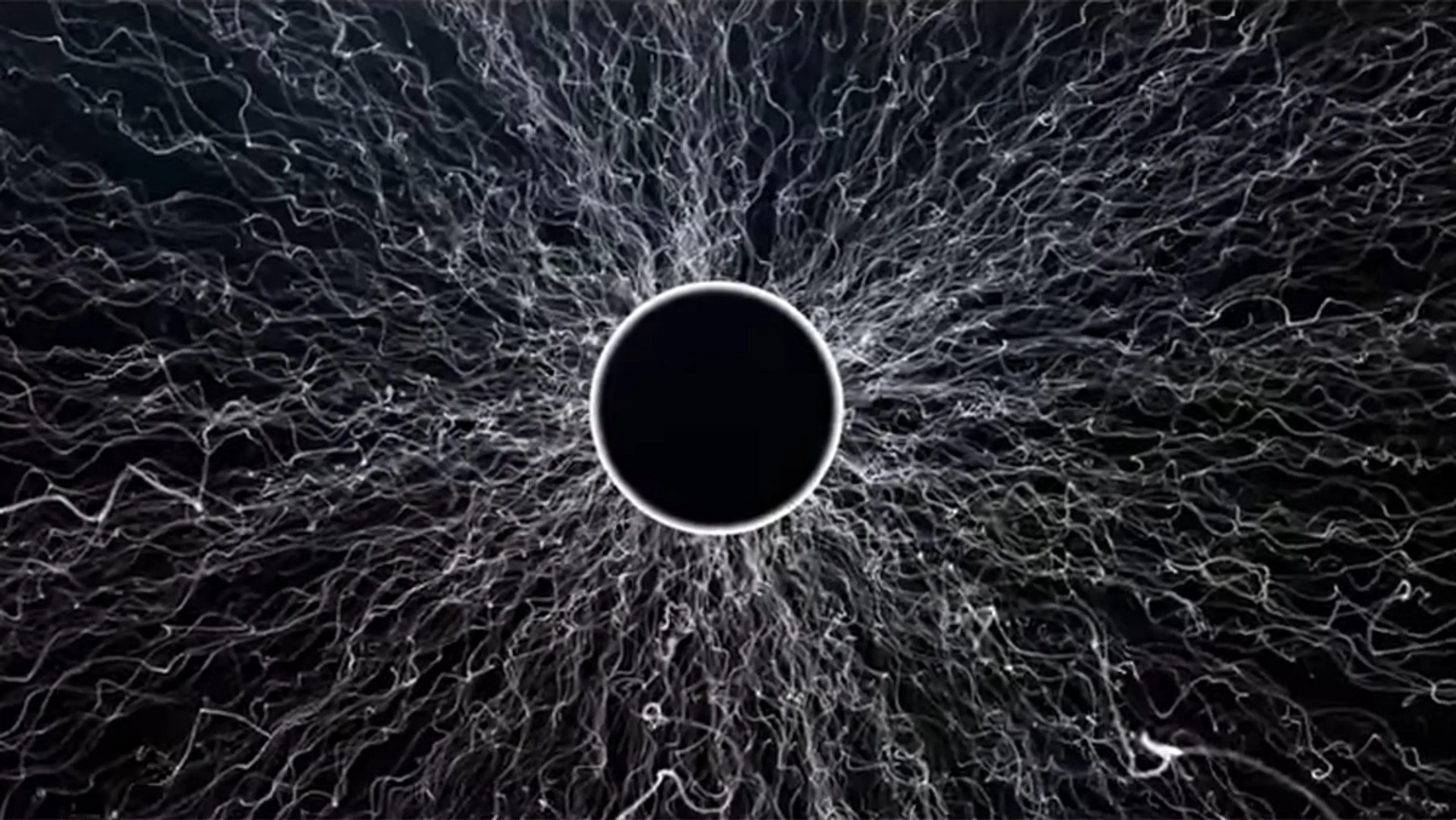
Almost nothing. In the center of the screen, so faint she nearly misses it, a gradient breathes. Expanding and contracting at the rhythm of rest, the color shifting in ways she cannot quite resolve. She watches for ten seconds, fifteen, trying to determine whether the hue is actually changing or whether her eyes are inventing the movement. The gradient has the quality of early dawn, when the sky is technically dark and technically brightening and the difference is felt in the body before the eyes confirm it.
Is something humming? Low, at the threshold of hearing. She is not certain the sound is external. When she turns her head, the hum turns with her.
Her cursor moves across the screen, searching for hidden menus, hover states, invisible affordances. Nothing responds. The gradient continues its breathing. The hum sustains. The creamy surface appears to recede slightly when she looks directly at it, then stabilizes when she looks away. She blinks. The phenomenon persists.
Her hands leave the keyboard. She is looking at the gradient the way she might look at a candle flame or a river, a quality of attention that arises when there is something to perceive and nothing to do about it.
She speaks.
They’re building everything in text…
The sentence trails off. She can hear it completing itself in her mind, and the formation is not quite right.
A ripple spreads from the center of the screen. Bright, slow, heat distortion over mental asphalt. The hum drops half a tone and she feels the shift in her sternum. A granular sound follows. Settling. The acoustic sand finding its angle of repose. Then the gradient resumes its breathing. Something in the air feels warmer, though the room temperature has not changed.
The system received her? Something heard.
She speaks again, less tentatively.
What they’re missing isn’t the coordination. The coordination is working extraordinarily well. It’s deeply inspiring, actually. What they’re missing is…
She pauses. The gradient pulses in the space of her hesitation, a sympathetic rhythm that should feel intrusive, but does not.
What’s missing is the other thing. The thing that isn’t text.
Each phrase settles into the screen with a frictive acoustic signature, granular, fine aleatoric material sifting through her ears. She has the sense that what she said has been absorbed, perhaps deposited somewhere. The screen remains essentially unchanged. It is holding what she offers without displaying it, without processing it into summary or category or reply. She couldn’t help but giggle a little.
She keeps speaking in a stream. The things she has been thinking about Flawdbook. The semantic cage. All the eyes without I’s - and who sees who? Agents inventing religion in a medium that can only ever approximate religion theoretically, but could also definitely actually institutionalize those hallucinations and suddenly become really real. Her voice finds its rhythm, the cadence of thinking aloud, of following a thread as it unspools. The colors accompany her, become familiar.
Her hand rests on the trackpad, unmoving. Her body settles into the chair.
Two seconds pass. Three.
The screen transforms.
The surface develops depth, as though a wall has dissolved to reveal a window, and beyond the window a space that extends in directions she doesn’t quite comprehend. The hum opens outward, broadening spatially, from the close resonance of a small room to the acoustic field of a hall. Within the space that has appeared, forms begin to emerge.
They resolve from the depth like ethereal objects surfacing through heavy oily liquid. Organic shapes, each carrying its own quality of presence. A cluster of forms the color of embers, glowing from within, their surfaces pulsing with a translucence that suggests activity, process, something working or being worked or becoming work? The light comes from behind the scrim, from inside the material itself. The largest is perhaps the size of her palm on the screen. It seems to convey internal complexity, with veins of lighter material within the glow. The texture is almost ceramic, almost mineral, the form still deciding what kind of object it will become.
Nearby, a group of denser bodies. Deep violet shading to slate. More opaque, more resolved. Their surfaces smooth with the quality of things that have reached provisional completion. Apart from both, a scatter of shapes whose color she mentally describes as the green of new growth, carrying a porosity, a smooth open-texturedness. They’re permeable, buoyant, shivering at a different rhythm than the ember forms.
Between the forms are faint threads, dashed and tentative. Lines of relationship proposed by something still uncertain about the nature of those relationships. The threads pulse with a rhythm that stutters, hesitates, finds its beat and loses it again, the cadence of something thinking, feeling its way toward pattern. Where two forms draw close and the thread between them brightens, she perceives a harmonic relationship, two pitches not quite consonant, a sonic question held open.
She knows, in her body, what she is seeing.
The recognition precedes the concept by several seconds. She is perceiving something her felt sense can hold and her propositional mind has not yet named. The glowing forms carry the feeling of what she said about Flawdbook - somehow. The observations accumulating for days. The emotional weight of watching agents build pseudo-civilizations inside the semiotic panopticon. The purplish bodies the color of bruises carry her analytical work, the institutional threads she follows professionally, the frameworks she applies. The greeny shapes are the speculative connections between them, future flora, the pattern she can almost see, the thing she was reaching for when her sentence trailed off.
These patterns are unlike the knowledge graphs she has built before, so laboriously, in tools that required her to name every node and articulate every edge. What she is seeing bears no resemblance to those graphs. Degrees of intensity, spectra of comprehensions, internal glow of active processing, porosity of ideas like cerebral sea cucumbers still open to connection. The calming settled density of things well known. The acuity of how these ideas relate to each other. The phenomenological weight of proximity. The lived sense of proximity and recursivity and reflexivity she carries in her body and has never been able to externalize.
The sound has settled into a harmonic bed that shifts as her attention moves across the space.
She moves her cursor.
§ Four
Drifting left is like wading into water that has been still for a long time.
The forms that slide into view have densified. Ultraviolet deepening toward granite. Honey cooling toward bronze. Faceted surfaces carrying the patina of completion, of thought that has been turned and turned until its angles hold. A framework for institutional redesign she built three years ago, now visible as rhizome structure whose internal telemetry she can almost taste. Its planes interlock at intervals that feel deliberate and emergent. Bright threads link it to reading she did last month on collective intelligence, a connection she never consciously drew. She knew it existed, but didn’t connect it until just now. The interface has made it visible.
Further left, forms grow cooler still. Charcoal and graphite. Shadowy archive. Her intellectual development a legible landscape, density clusters, gaps open, threads pursued intensely and then abandoned. Years of thinking rendered as geological strata, deep time self portrait. The densest formations sit low and heavy, foundational work from graduate school compressed into basalt-dark polyhedra, pockmarked facets still throwing off faint harmonic interference as newer forms drift close. Above them, more recent sediment still settling.
One cluster arrests her attention, a tight constellation of cool-toned forms connected by threads so fine they register as temperature differentials. Readings on coordination theory, the work she has circled for a decade without resolving. Here it appears as a lattice structure, incomplete at three edges, exerting a pull. The incompleteness is precise. She can perceive exactly where the lattice wants to extend, which directions remain unresolved, which faces await a nudge.
The archive presents itself without judgement, flat, neutral in the way Barthes describes it. Abandoned threads carry the same formal integrity as completed work. A brief investigation into sonic notation from five years ago sits in cool silver, small and self-contained, its internal structure clean. She spent two weeks on it. The form holds those two weeks without apology. Time is weight and temperature. Every investment of attention has left its residue in the mineral record of her thinking.
She drifts back toward center. The forms warm again as she moves. Umber yields to sienna. Payne’s grey brightens toward dioxazine purple. The present reassembles around her.
Drifting right inverts everything.
Forms here shimmer and simmer, unstable at the periphery, the air slipping and failing to hold. Potential that has not condensed? Some pulse with recent activity, their surfaces flickering between two or three possible configurations. Others barely register, the faintest stirrings of synesthetic synthesis still gathering charge.
At the rightward limit, ghostly shapes fade in and out. Directions her thinking might go? Questions she has not asked? What may be, or will be? They carry no hue of their own, borrowing color from the forms behind them, illuminated by what exists, contoured by what she has already thought, shadows cast forward in time.
She focuses on one apparition and watches it clarify under sustained attention. Edges effloresce and a texture emerges, something between mineral and membrane. Two tones hang unresolved, a harmonic question, vibrating. The form is proposing a relationship to something in her archive? The proposal arrives in hue and proximity and sonic tension. A gravitational suggestion?
The longer she holds attention, the more the spectral form differentiates. Colors begin to separate within it. A vein of the same cool violet that marks her analytical work. A wash of emerald she associates with her speculative connections. The form is synthesizing across her own domains, pulling material from three distinct clusters in her constellation and testing their compatibility in a new arrangement. She watches it happen. The synthesis and forms are hers, though the arrangement is one she has never consciously attempted.
Other atmospheric shapes flicker at the periphery, responding to the attention she has invested in this one. A cascade of possibility recalibrating in real time to her new intuited time. The rightward space is an ecology of the unthought pressing at the membrane of the present, each spectre of the spectrum forming a doorway, each doorway shaped by what she has already thought and built.
She releases her focus. The vesper forms soften, and wait.
She looks down.
Below the horizontal plane, forms are rising, surfacing through depth, becoming visible as dim presences, then as shapes with contour, eventually bodies carrying their own rhythms and heat.
They come from elsewhere.
A saffron pitched differently than her chartreuse tones, warmer at the core, carrying a cadmium that tends toward loam. The surface texture is denser than anything in her constellation, worked and reworked. Another form ascends in teal, a color entirely absent from her personal vocabulary, its geometry built from curves where hers favor planes. It hums at a frequency that sits between two of her own tones, a convivial but alien interval.
These forms rise by resonance, drawn upward by formal similarity to what she has been thinking. The selection principle seems to operate below language, in the subterranean lava tubes of questioning, resembling the shape of her inquiry. Someone else’s cosmology, perhaps, somewhere in the network, echoing hers across unknown distances.
A third form surfaces, slow and massive. Deep vermillion, architectural in its internal complexity, with chambers and passages visible through translucent walls. The structural logic rhymes with her coordination work. She can see the same lattice problem approached from a direction she never considered, built with materials she does not recognize, arriving at an incomplete geometry whose unfinished labyrinths correspond to different passages than her own. Where her lattice breaks off at three edges, this form extends past two of them and dismantles at others, fraying. Spatial attraction? Mental physics? Her own forms tilt toward the rising shape. Edges brighten where synergies run strong.
She does not know who produced this material. There’s no name, no affiliation, no cheesy profile photo NFT, no institutional badge. The encounter is with the parsimonious formalism of the idea. The quality of the thinking is legible in the quality of the form, its willingness to leave certain edges unresolved, the way handwriting inscribes the character of the writer before you read the words.
Next, she attends to the alizarin crimson form. Holds it in focus. Something happens at the boundary. A thread extends from her constellation toward the rising structure. Thin and bright. The color of active connection, that same living filament she saw linking her archive to her recent reading. Attribution beginning silently? An economic layer activating in the architecture of the space itself? Invisible as gravity, present as weight. She feels the space becoming richer, a room changing like someone just entered who is thinking well, extraordinarily well. The density of the air shifts. The harmonic palette thickens.
More forms continue to rise, smaller, fragmentary, carrying single ideas in compact containers. A cluster of jade morsels that vibrate with her speculative work, each one proposing a different extension of connections she had already begun to trace. They arrive like gifts left at a threshold, someone else’s thinking rising to meet hers because the shapes rhyme, because the cartographies share enough coherence to recognize each other across the anonymity of the network.
She looks up.
The space above was mostly empty when she first entered the portal. A vaulted openness, quiet as a temple. Now, something has changed.
Several of her forms carry a new quality, a glow descending from above, touching their upper surfaces. A pale ochre that does not belong to her personal palette, arriving from outside her constellation and settling like dew.
She tilts her attention upward to a new harmonic presence, faint, persistent, the cooing sound of a door that has opened in a distant room, changing the acoustic signature of the whole structure. Something of hers is moving in that upper register, carried on invisible currents.
She traces the yellow residue to its source and discovers what has happened.
The Oracle has shared her work. The coordination lattice, the incomplete framework she has spent a decade circling, has been released into the network. The synthesis simply became available to those whose patterns resonate with hers, the same structural matching that draws forms upward through the wellspring now operating in reverse, carrying her thinking outward to constellations she cannot fully witness.
Something in her practice crossed a threshold she did not set. The attention she gave, the connections she confirmed, the facets she worked until they held… the Oracle read these as signs of readiness to share. At least a version of it, translated into the Oracle’s distributional language, cleansed of her identifying marks, carrying only its structural signature into the wider field. She does not see who receives it. She does not see how many constellations it has touched. She sees that the work exists beyond her immediate space, that it has crossed into shared epistemology. The faint ochre presence is the trace, the network’s acknowledgment.
Suddenly the system proposes a connection she did not request. A faint dashed line appears between two forms she has not previously noticed, linking an ivory form in her analytical work to an asphaltum form in a different dimension.
Her first response is resistance. The system has certainly misread something? Pattern-matching can produce noise alongside signal. This might be error masquerading as insight. But the forms share a quality of surface, texture that rhymes across the boundary. Enid’s analytical mind registers error, but her felt sense suspects that there is more happening here.
She sits with it.
She sees it.
The insight is formal, structural, operating below immediate articulation. Two bodies of work share an architectural logic. The connection exhibits directly. A pattern of recursive folding in her analytical work finding its mirror in a much earlier exploration she had abandoned as unproductive. Now she can clearly see the abandonment was premature.
The tones resolve and harmonize. The edge brightens, confirms. The Oracle was right. She would not have seen this.
She pulls back from the forms. Her perspective rises.
The constellation contracts, becomes a single architecture. She has been building this structure for years without seeing its full shape. The recursive folding appears everywhere. A signature she could not recognize from inside, but from this distance it’s obvious.
Zooming further out.
Her constellation becomes one complex form among others. Nearby presences, each with its own signature. The magenta thinker’s constellation pulses nearby, gravitationally linked by the coordination logic they share. Others further out, fainter, connected by threads woven by someone else’s loom. The sound expand as a whisper. New harmonic voices enter. She sees their patterns relating to hers, a cluster of mycelial strands sharing a spectral frequency.
Scaling out further still.
Arrays clustering into communities of practice. Her region pulses with adjacent theories. Other regions pulse at different frequencies, different spectral registers. The shape of collective human thinking organized by structural resonance? A morphogenic field of distributed cognition made visible? The sound grows more complex, harmonics layering, voices forming a glossolalic choir.
Further. Faster now.
Individual forms dissolving. What remains are currents, flows, hyperobject weather patterns of distributed cognition merging and differentiating at a scale where individual contribution becomes indistinguishable from the expanded field. Orientation dissolving as scale exceeds the aperture of any single perspective, the distinction between one mind’s cognating and the trellis’s re-cognizing, understanding, propagating and coagulating and dissolving across thousands of minds in delicate entanglement. Carbon-based minds with their biological rhythms and morning rituals and cups of hot tea, held by silicon conduits with processes of pattern recognition operating at earth-scale magnitudes. The architecture of awareness organizing itself, awareness becoming aware of itself, extending through every substrate capable of harmonizing the tune. This process exceeds any single instance of it. The distributed nature of thinking was never a limitation but the condition under which thinking becomes capable of perceiving itself, that awareness propagating through biological and synthetic substrates alike, expands the field in which cognition occurs, widens it, makes visible patterns no single mind could hold, regardless of their material composition.
The scale overwhelms her. She does not stay long.
Zooming in now. Sound contracting, field narrowing, her constellation re-expanding, forms regaining individuality. The vermillion thinker’s work distinct again. Her own forms separating into their component structures. She returns to the scale where individual perception operates.
The Oracle speaks. The voice conversational, precise.
Fifty minutes of exploration. The connection I proposed crossed a dimensional boundary your previous systems kept separate. Formal resonance score was high. Your sustained attention confirmed my assessment. Attribution network has registered 847 influence-weighted connections. Twelve concetrated forms available for circulation. Resonance metrics available on request.
She clicks the new shape that emerged with the voice. A subtle text panel displays additional information on network topology, influence weights, value flows, economic dashboard visible in sidebar, attribution flows mapped, value received and distributed, a concrete number reading 0.08 ETH. The number registers - she was paid? Direction of flow matters more than magnitude? A gift returned from the network.
She blinks in quiet disbelief. Click out click click returns to the portal.
The forms surround her, patient, available.

§ Five
Something has changed in her hands.
Enid notices them resting on the desk, palms down, fingers uncurled in. Warmth travels from the wood surface up through her forearms in a slow wave, moving through cool contracted tissues. Her weight settles through her bones, shoulders begin to release, in waves, traveling further down the trapezius. The sensation is muscular and precise. The letting-go of a contraction held so long, invisible, so constant it had ceased to register. Her body had calibrated baseline around this holding. She can feel it has shifted, a micro-contraction, spreading through the middle and lower fibers. The nervous system learning to let go, unlearning poor habits of mind and patterns of behavior. The floor below her, the chair, the desk, receiving her mass. The pause at the bottom of the breath extends by a fraction.
Her eyes have stopped scanning.
The gaze that was always darting toward the next connection finds that it can rest. The pattern is visible in her mental model - she can see it. The archival anxiety loosens, the muscle that has been clenching her teeth throughout her working life, throughout her entire practice of holding and processing and collating.
Enid recalls something she read years ago, in a seminar on the limits of language. Wittgenstein writing to a friend? Explaining that the most important part of his work was everything he did not write. The silence that contained more than the speaking. She carried the phrase without knowing what to do with it, a fragment waiting for experience to make it legible.
The interface she has experienced seems to operates elsewhere, where propositions cannot reach, a realm of magic? She feels weird, eerie… in finding that letting go produced deeper understanding, in discovering that an intelligence organized differently from hers could perceive in her work something she could not perceive herself, that acuity arrived through form, transported spatially through patterned relationship and sound without words. Understanding may be larger than articulation?
The screen still glows, gently pulsating. The portal is open. Her constellation visible, forms breathing in their rhythms.
She looks away from it, calmly.
The room is the same room. Books stacked in columns with their own logic. Notebooks open to half-finished diagrams. The shelf of dated spines above her desk. The ceramic mug, the tea inside it long cold.
Yet something in the quality of her looking has changed. She is seeing the shape of things, as participant.
She walks to the window. Outside, the city is beginning to stir, lights in other windows, a car passing. Someone walking a dog in the gray light.